Why This Matters
Construction is one of Australia’s largest industries, employing roughly 1.36 million people, and recent Safe Work Australia data still places it among the industries with the heaviest serious-claim burden. At the same time, construction sites are temporary by design.
Fencing lines move, compounds are resized, trades rotate, scaffold goes up and down, and the parts of the site worth protecting on day 20 are often not the same parts worth protecting on day 120. That creates a familiar security problem for builders and principal contractors: by the time a permanent camera solution becomes practical, the risk has already moved.
Plant, tools, fuel, cable, switchboards and temporary amenities can sit exposed overnight, and an incident discovered at 6:00 am may already have created programme delay, subcontractor friction and insurance admin before the project team has even opened the site. For many active projects, the question is not whether security matters.
It is whether the security model can keep pace with a site that is unfinished, reconfigured weekly and under pressure to keep delivering. Those pressures are amplified by delivery deadlines and subcontractor sequencing.
A loss or access failure on a live project rarely stays contained to one trade package, because missing plant, unclear movement records or delayed evidence can quickly spill into programme conversations, client updates and unplanned supervisory time that no site team really has to spare.
How Connect Services Would Respond
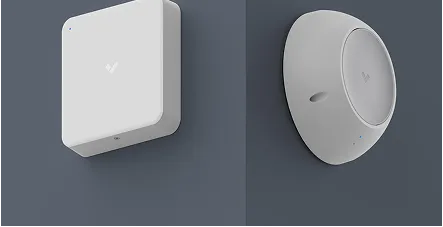
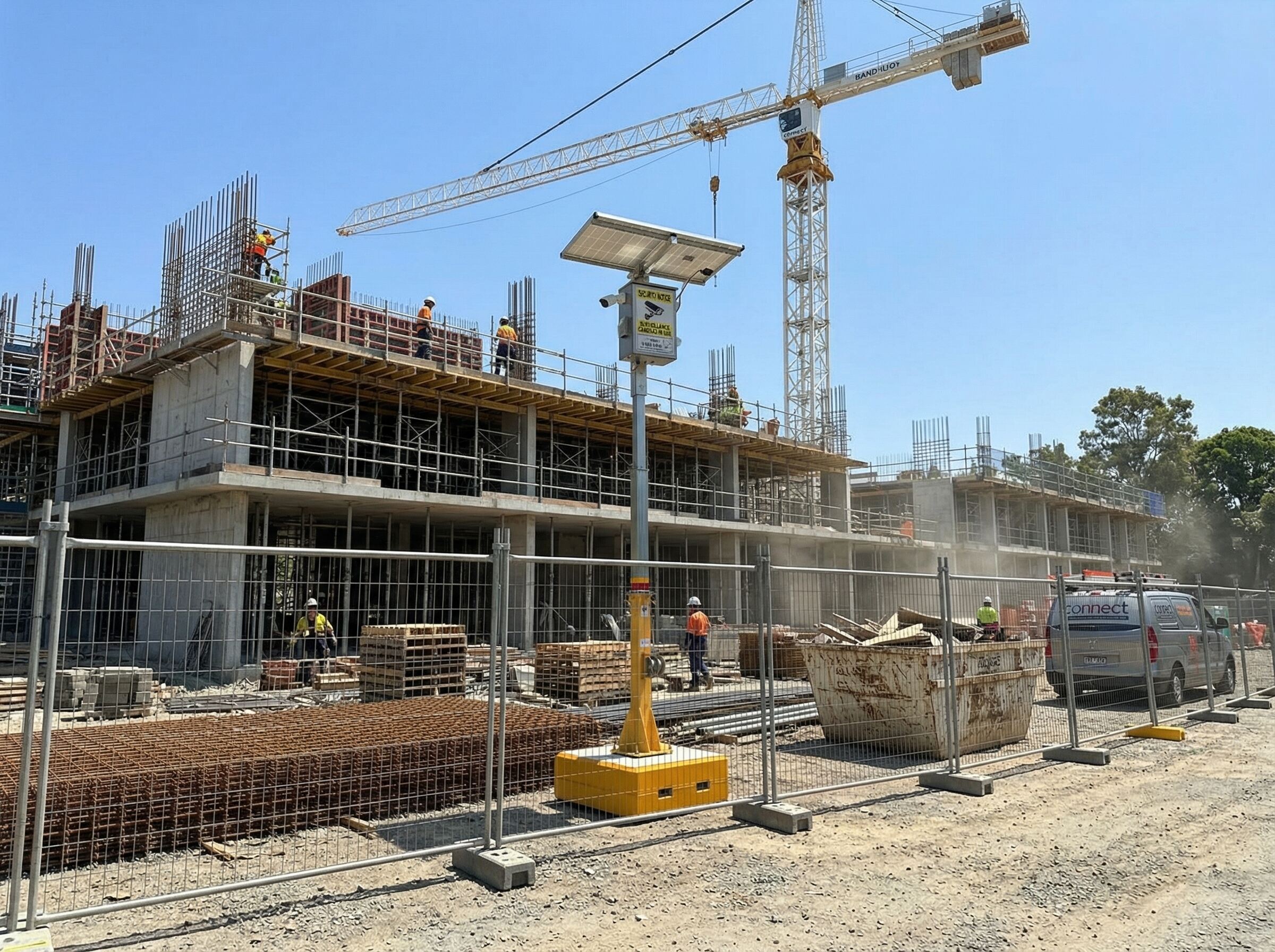
That is where Connect Services would normally start with portable security solutions and, where the risk profile suits it, extend into solar security camera deployments for compounds, laydowns and changing work fronts. Rather than anchoring the design to one fixed office or comms cupboard, Connect Services would deploy rapidly installable units that can be positioned around entry gates, tool storage, car parks, temporary offices and high-value material zones, then relocated as the build progresses.
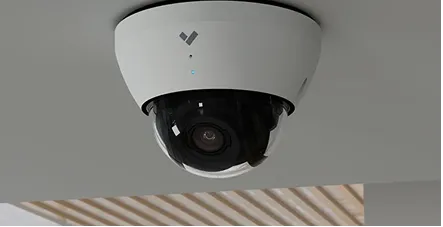
Within broader commercial construction environments, the platform would give project managers, site supervisors and authorised stakeholders remote access to live activity, recorded footage and alert review without forcing them to wait for a facilities manager or IT contractor to retrieve local files. If a site later matures into a more permanent phase, the portable layer can sit alongside fixed cloud-managed cameras rather than being discarded as a short-life interim measure.
That staged flexibility matters on construction work because site conditions are temporary by nature. Security needs to move with the programme, support multiple subcontractors and remain useful through handover phases, defect periods and new project starts without forcing the builder to procure a completely different operating model every time the footprint changes.
What This Could Improve
The commercial benefit is less about hype and more about responsiveness. Portable surveillance would not stop every break-in or vandalism attempt, but it would let a project team understand what happened faster, preserve higher quality evidence and reduce the blind period between an incident taking place and someone being able to act on it.
That matters because construction losses have a knock-on effect far beyond the item stolen. Missing tools can delay critical work, damaged temporary infrastructure can force rework, and poor evidence can leave the principal contractor stuck between subcontractor claims, client expectations and insurer questions.
A cloud-managed record helps establish timeline, direction of travel, access point and follow-on movement across the site, which usually makes investigation and escalation simpler. It also allows the security footprint to follow project reality.
As one stage finishes and another opens, the system can be repositioned without restarting the whole procurement process. For builders managing several active sites at once, that portability can be just as important as the footage itself because it turns security into a deployable resource rather than a sunk cost tied to one address.
In practice that gives project teams a better basis for coordinating with subcontractors, clients, insurers and internal leadership when something goes wrong. The footage or access trail does not just support a security decision.
It helps preserve delivery confidence by reducing the uncertainty that often turns one incident into several avoidable commercial conversations.
Next Step
The right rollout normally begins with a practical map of where loss, delay and liability would hit hardest over the next 60 to 90 days, not a theoretical final-state security plan. Connect Services would use that short-horizon lens to recommend which areas need immediate portable coverage, where alerts should flow after hours and how the evidence should be used by project teams when incidents occur.
A good construction rollout therefore tends to start with the work fronts, compounds and workflows most exposed over the next few months, not a theoretical final-state design.
Once the response model is working on live sites, it is far easier to replicate across new projects and future phases with much less friction.
For builders, head contractors or developers reviewing temporary security across active works, start with the portable security options and then contact Connect Services to discuss a portable CCTV deployment that can move with the site instead of lagging behind it.